komm.CrossQAMConstellation
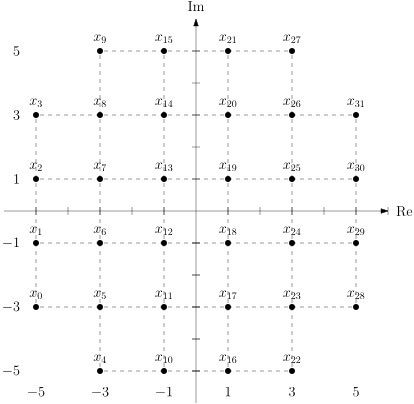
Cross quadrature amplitude modulation (cross-QAM) constellation. It is a complex one-dimensional constellation defined only for orders $M = 2^k$ with $k$ odd and $k \geq 5$ (that is, $M = 32, 128, 512, \ldots$), for which a square QAM constellation does not exist. More precisely, start with a smaller square QAM constellation with order $2^{k-1}$ and extend each side of the QAM square by adding $2^{k-3}$ points, ignoring the corners in this extension; this leaves a total of $2^{k-1} + 4 \cdot 2^{k-3} = 2^k$ points resulting in a cross shape. Equivalently, it may be obtained from a bigger $L \times L$ square QAM constellation, where $L = 3 \sqrt{2^{k-3}}$, by removing the four corner regions. For more details, see Hay04, Sec. 6.4.
Parameters:
-
order(int) –The order $M$ of the constellation. Must be of the form $M = 2^k$ with $k$ odd and $k \geq 5$.
-
delta(float) –The distance $\delta$ between adjacent symbols (along the in-phase and quadrature axes). The default value is
2.0. -
phase_offset(float) –The phase offset $\phi$ of the constellation (in turns, not radians). The default value is
0.0.
Examples:
The $32$-cross-QAM constellation with $\delta = 2$ is depicted below.
>>> const = komm.CrossQAMConstellation(32)
matrix Array2D[complexfloating]
cached
property
The constellation matrix $\mathbf{X}$.
Examples:
>>> const = komm.CrossQAMConstellation(32)
>>> const.matrix
array([[-5.-3.j],
       [-5.-1.j],
       [-5.+1.j],
       [-5.+3.j],
       [-3.-5.j],
       [-3.-3.j],
       [-3.-1.j],
       [-3.+1.j],
       [-3.+3.j],
       [-3.+5.j],
       [-1.-5.j],
       [-1.-3.j],
       [-1.-1.j],
       [-1.+1.j],
       [-1.+3.j],
       [-1.+5.j],
       [ 1.-5.j],
       [ 1.-3.j],
       [ 1.-1.j],
       [ 1.+1.j],
       [ 1.+3.j],
       [ 1.+5.j],
       [ 3.-5.j],
       [ 3.-3.j],
       [ 3.-1.j],
       [ 3.+1.j],
       [ 3.+3.j],
       [ 3.+5.j],
       [ 5.-3.j],
       [ 5.-1.j],
       [ 5.+1.j],
       [ 5.+3.j]])
order int
property
The order $M$ of the constellation.
Examples:
>>> const = komm.CrossQAMConstellation(32)
>>> const.order
32
dimension int
property
The dimension $N$ of the constellation.
For the cross-QAM constellation, it is given by $N = 1$.
Examples:
>>> const = komm.CrossQAMConstellation(32)
>>> const.dimension
1
mean()
Computes the mean $\mathbf{m}$ of the constellation given prior probabilities $p_i$ of the constellation symbols. It is given by $$ \mathbf{m} = \sum_{i \in [0:M)} p_i \mathbf{x}_i. $$
Parameters:
-
priors(ArrayLike | None) –The prior probabilities of the constellation symbols. Must be a 1D-array whose size is equal to the order $M$ of the constellation. If not given, uniform priors are assumed.
Returns:
-
mean(Array1D[complexfloating]) –The mean $\mathbf{m}$ of the constellation.
For uniform priors, the mean of the cross-QAM constellation is given by $$ \mathbf{m} = 0. $$
Examples:
>>> const = komm.CrossQAMConstellation(32)
>>> const.mean()
array([0.+0.j])
mean_energy()
Computes the mean energy $E$ of the constellation given prior probabilities $p_i$ of the constellation symbols. It is given by $$ E = \sum_{i \in [0:M)} p_i \lVert \mathbf{x}_i \rVert^2. $$
Parameters:
-
priors(ArrayLike | None) –The prior probabilities of the constellation symbols. Must be a 1D-array whose size is equal to the order $M$ of the constellation. If not given, uniform priors are assumed.
Returns:
-
mean_energy(float) –The mean energy $E$ of the constellation.
For uniform priors, the mean energy of the cross-QAM constellation is given by $$ E = \frac{\delta^2}{192} (31 M - 32). $$
Examples:
>>> const = komm.CrossQAMConstellation(32)
>>> const.mean_energy()
20.0
minimum_distance()
Computes the minimum Euclidean distance $d_\mathrm{min}$ of the constellation. It is given by $$ d_\mathrm{min} = \min_ { i, j \in [0:M), ~ i \neq j } \lVert \mathbf{x}_i - \mathbf{x}_j \rVert. $$
For the cross-QAM constellation, the minimum distance is given by $$ d_{\min} = \delta. $$
Examples:
>>> const = komm.CrossQAMConstellation(32)
>>> const.minimum_distance()
2.0
indices_to_symbols()
Returns the constellation symbols corresponding to the given indices.
Parameters:
-
indices(ArrayLike) –The indices to be converted to symbols. Must be an array of integers in $[0:M)$.
Returns:
-
symbols(NDArray[complexfloating]) –The symbols corresponding to the given indices. Has the same shape as
indices, but with the last dimension expanded by a factor of $N$.
Examples:
>>> const = komm.CrossQAMConstellation(32)
>>> const.indices_to_symbols([12, 0])
array([-1.-1.j, -5.-3.j])
closest_indices()
Returns the indices of the constellation symbols closest to the given received points.
Parameters:
-
received(ArrayLike) –The received points. Must be an array whose last dimension is a multiple of $N$.
Returns:
-
indices(NDArray[integer]) –The indices of the symbols closest to the received points. Has the same shape as
received, but with the last dimension contracted by a factor of $N$.
Examples:
>>> const = komm.CrossQAMConstellation(32)
>>> const.closest_indices([-1.1 - 0.9j, 5.2 + 5.1j])
array([12, 31])
closest_symbols()
Returns the constellation symbols closest to the given received points.
Parameters:
-
received(ArrayLike) –The received points. Must be an array whose last dimension is a multiple of $N$.
Returns:
-
symbols(NDArray[complexfloating]) –The symbols closest to the received points. Has the same shape as
received.
Examples:
>>> const = komm.CrossQAMConstellation(32)
>>> const.closest_symbols([-1.1 - 0.9j, 5.2 + 5.1j])
array([-1.-1.j,  5.+3.j])
posteriors()
Returns the posterior probabilities of each constellation symbol given received points, the noise power, and prior probabilities.
The posteriors are computed under the Gaussian channel model $Y = X + Z$, assuming that each received point is the transmitted symbol corrupted by additive Gaussian noise of power $\sigma_Z^2$. For real-valued constellations the noise is real Gaussian with variance $\sigma_Z^2$; for complex-valued constellations it is circularly symmetric complex Gaussian, with the noise power equally divided between the real and imaginary parts, i.e., $\mathrm{E}[\mathrm{Re}\{Z_n\}^2] = \mathrm{E}[\mathrm{Im}\{Z_n\}^2] = \sigma_Z^2/2$.
Parameters:
-
received(ArrayLike) –The received points. Must be an array whose last dimension is a multiple of $N$.
-
noise_power(float) –The noise power (variance) $\sigma_Z^2$.
-
priors(ArrayLike | None) –The prior probabilities of the symbols. Must be a 1D-array whose size is equal to $M$. If not given, uniform priors are assumed.
Returns:
-
posteriors(NDArray[floating]) –The posterior probabilities of each symbol given the received points. Has the same shape as
received, but with the last dimension changed by a factor of $M / N$.
Examples:
>>> const = komm.CrossQAMConstellation(32)
>>> const.posteriors([-1.1 - 0.9j], noise_power=2.0).round(3)
array([0.   , 0.   , 0.   , 0.   , 0.   , 0.011, 0.101, 0.017, 0.   ,
       0.   , 0.   , 0.068, 0.613, 0.101, 0.   , 0.   , 0.   , 0.008,
       0.068, 0.011, 0.   , 0.   , 0.   , 0.   , 0.   , 0.   , 0.   ,
       0.   , 0.   , 0.   , 0.   , 0.   ])